Since 1986, the Network and Systems Professionals Association has assisted thousands of Technology Professionals in finding employment, educational, and career development opportunities worldwide.
NaSPA Technical Support Magazine On- line Archive
Find the 2016, 2015 and 2014 editions here, OR…
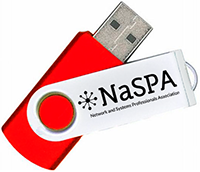
Get every issue on a thumb drive, along with an expansive NaSPA software archive and more, for only $49. FREE when you join NaSPA as a Full Voting Member. Find more details on this page or in the
Membership section.
NaSPA President Awarded U.S. Patent
It’s a nightmare for emergency managers: Who is dialing 911 but not getting through? NaSPA President Leo A. Wrobel has been awarded a U.S. Patent on technology that uses Signaling System 7 (SS7) to identify blocked callers when all circuits to 911 are busy.
Until now SS7 has been used almost exclusively by phone companies, and it hasn’t evolved much in decades. U.S. Patent No. 10,812,663 promises to change all that. The trade name for this technology is TeleSentient®.
How TeleSentient® Works
Most laypeople do not realize that the wireless and landline networks we all use each day are really two networks. One is the voice network that carries our speech. The other is a data path that tells the voice network what to do. Leo A. Wrobel, inventor of TeleSentient® is a longtime disaster recovery expert and NaSPA President. His invention uses the SS7 data network to reveal the impact of disasters and mass calling events on real people, in real time.
Stated another way, dialing every phone in America to look for people in trouble would be annoying and impractical. Wrobel has patented a process to do much the same thing, but in seconds, and without having to call anyone’s phone. According to Leo:
“It’s easy to spot a disaster. Anyone can turn on the news. The problem is knowing WHO the disaster is affecting before it’s too late to help them.”
TeleSentient® data can be displayed in a Network Operations Center, on a personal computer, or on a smart phone after it is combined with external data. Imagine a tornado on a weather radar screen that also displays every 911 caller in the vicinity at that moment. In fact, available tools such as the DisasterAWARE® application by the Pacific Disaster Center can be enhanced with TeleSentient®.
The Pacific Disaster Center produces a variety of products that assess impacts of a disaster on lifelines, including power, communication, and transportation. Knowing where the power is on and where the phones are working are vital components of effective planning and response. - Ray Shirkhodai, Executive Director Pacific Disaster Center
TeleSentient® can operate in a “passive observation” mode, scanning for trouble. When this capability is combined with visualization tools like DisasterAware® it allows users to spot problems literally as they happen. “Hey, Tulsa just turned red on the display. I wonder what happened there?”
In some cases the “red” area might not be a disaster at all. It could just as easily be a mass calling event due to a riot or a large swing in financial markets. TeleSentient® spots these events as well, opening up even more possibilities for this technology. After all, who would not want to know when all of Wall Street’s lines turn red at once or that a dozen unanswered 911 calls are coming from a grade school?
NaSPA President Leo A. Wrobel was first in the U.S. to build a Disaster Recovery Center in a telephone office and first to run phone traffic on the Dallas cable TV system. He has consulted on disaster recovery for hundreds of Fortune companies and serves as an Expert Witness in high-stakes technology disputes. His companies have designed ingenious systems to improve emergency response, safeguard e-commerce and save lives for over 35 years.